|
| Rendering the film |
 |
| Selecting a sound clip |
 |
| Testing sound Clip loop |
 |
| Loop creates constant ringing |
 |
| The entire sequence |
 |
| Sound cut into timeline |
 |
| Cutting into sound (in point) |
 |
| Razor blade tool |
 |
| Razor blade tool used to cut files and insert new shot |
|
| Rendering the film |
|
| Selecting a sound clip |
|
| Testing sound Clip loop |
|
| Loop creates constant ringing |
|
| The entire sequence |
|
| Sound cut into timeline |
|
| Cutting into sound (in point) |
|
| Razor blade tool |
|
| Razor blade tool used to cut files and insert new shot |
 To begin with, we had the name 'Trapped' in mind and used this name throughout our pre-production and production, but now we are at the post-production point and we chose to get a title with more meaning and research into making a thriller title. To the left is why we chose to change it.
 I am doing the 2008 Rambo film mainly because I also analysed this film in my Thriller research post, but also because the title sequence is quick and goes by in a flash. Beginning with the institutional info, there are only two. Millenium films and Equity Pictures are the only two shown, with their logos flashing by the in the first few seconds, there is a sound bridge leading into the news report montage that I mentioned in the first research.
 After this montage, there's is the repeat of the institutional info. The font and colour fits someone who is on their way to break all the rules in the Geneva conventions. A dirty and rough Serif font in a deep red symbolising the blood of the East-Asian army the Protagonist is going to spill. As it is revealed on the black background that this is "A Film by Sylvester Stallone" the intro moves on into what I like to call: "This Is The Part Where We Show You The Bad Guy And Show You How Bad They Are" part, or TITPWWSYTBGASYHBTA for short.
 When the scene comes to a close, there is a short moment of total silence as we cut to the bad guy. The several string instrument Crescendos, building up to something that is about to drop jaws in the audience. As the violins and cellos peak into high pitch, the screen cuts to black and the title, 'Rambo' fades in with the red, rough font connoting blood and death. As it the title fades in, the violins are being drowned out by very loud wind instruments such as trombones. This brings the entire build up to a close by showing the audience what the build up was about. What follows is introductions of the Protagonist, Rambo, walking through the rainforest catching snakes as a living. The only text here is the actor's names in the same font seen before, but in white connoting everything is calm right now. The equilibrium before the disruption, according to Todorov's theory.
 This is very straightforward intro. Introduce the bad guys and MAKE SURE people know what they are watching. However, it also seems to reminisce in the past as the title font itself looks like an aged version of what was used in the original trilogy. What I do take from it however the contrast with the red and black and how the simplicity flows along in the sequence.
 The first institutional info is the iconic Metro Goldwyn Mayer lion. A sign of great movies and classics. Followed by 'Element Films' and 'Eden Rock Media', a rather long back screen is interrupted by a thud of what could possibly be am electronic drum kit. The text fades in and out of the screen with suspenseful music playing. I find this a perfect way to create enigma but I am unsure it could be implemented into my intro. What I find interesting is that it is only the one minute mark that the black screen fades away into the bathroom character introduction. The lighting, with limited use of the Fill light keeps everything dark and mysterious but also the orange, saturated tinge gives the film a very serious look with a pretty undertone. If there were stronger shadows I would almost say this is a Film Noir.
 One stark contrast between 'Mr Brooks' and 'Rambo' is just how much simpler 'Mr Brooks' is. Get all the institutional info out of the way first with no text appearing in the corner of the frame. No. Start with a black screen, show who is getting all the money and done! While the title in contrast with the rest of the intro. We are to introduced to Mr Brooks. A well off man with a few festering secrets. However, when he begins to speak out loud, everything does a U-turn. The edgy, suspenseful music stops and is replaced by calm piano and string piece. Instead of smooth and calculated camera movements (Focus pulls), It's a dissolve to a beautiful night city skyline. Now this change in pace is then used to show Mr Brooks family side. His happy life, open to the world, but this is very methodically planned. The piano is only there for a few seconds, but it calms everyone down. If not, the jump to psychotic murder in plain sight, to happy married, working man would be too much of a jolt. This creates a buffer of sorts, something which I might use, should I continue my story past the intro.


 This scene serves to introduce the characters as they have conversations at breakfast looking fine in their suits. Conversations vary but are in general somewhat crude which, along with the suits and smoking, are all stereotypical of criminal mobsters. The camera moves behind the characters and around the table, changing focus as the conversation did. By this I mean each conversation had a leaders that drove it and the camera would focus on them. Camera shots varied from Over The Shoulder Medium Shots to Big Close Ups and Medium Close Ups. This give the audience a very personal start to the characters, as if they are at the table too, among this group of friends and colleagues. Also for most of the shots, the camera is moving around the table, following who speaks, rather than a static frame.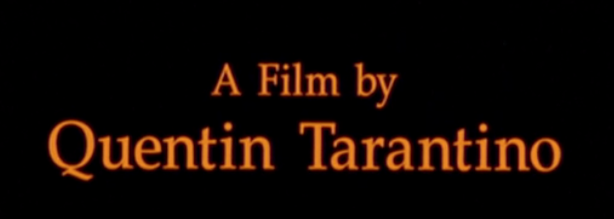
 Once the group decides to stop breakfast and character introduction, they walk out the cafeteria with some swinging 70's beats. We discover the film director with a short black screen to transition into the second scene, a badass walk, in slow mo, with music that without the name I could only describe as the slickest Jazz-Rock I've heard. This walking scene goes to every character, showing the actors's names at the bottom of the screen. The title is different from all the other text already shown. That was static. The title slid up from the bottom to the the top. Pandorum has something similar only it moves from behind the camera then away. But as the the Dogs keep walking towards what doesn't look like enough cars for them all, a small credit section for key people who worked on the film and then sounds of a screaming man crescendos until it cuts to a bloody scene.

 What to take from this film introduction. Being long can help with character development, especially when the plot is for the characters to solve a mystery. But also placing such long winded credits just to seemingly stretch the song out seems unnecessary. However, a sound bridge like this could be used in the buffer I mentioned in 'Mr Brooks' to help facilitate transfer. This almost seems like a reverse from 'Mr Brooks' where it went from somber to cheerful, this goes from "We're going to do crime" cheerful to "I'm bleeding to death on the leather seats" somber.
 This title sequence is quite interesting. Most of the title sequence is text over a
black screen, this continues from the colour and lighting from the previous
sequence. The previous sequence is practically shown entirely in black and
white, creating a gloomy starting scene. Blood almost seemly to be even bolder
on her face because it’s black on camera. So the black background works in synergy with same
colour and tone so there isn't too much difference between this and the next
shot which is of the woman lying down, also in black and white. The soundtrack which accompanies the title
sequence starts once the sequence before ends (with the gunshot) and continues
once the still-like image becomes the background. Although it isn't clear if it’s
a moving or still image. It still works in synergy with the black screen. Some
of the text in the opening credits represents a list type order. The text’s
colour is white so it stands out much easier on the black background and the
font is the same throughout. The actual title 'Kill Bill' has its own specific slide which comes after the institutional slides but before the life of stars/character names. The placement of this splits up the sequence and may suggest that time has passed from each part. This is because of the 'faded' like transition of the black screen. The black and white effect is lost once the sequence moves on and more colour is used.There is music which plays throughout the title sequence, starting immediately after the gunshot, not leaving much time for the audience to think before the time between sequences is delayed by the opening credits. The black and white sequence could suggest that the whole sequence is a flashback
This title sequence is quite interesting. Most of the title sequence is text over a
black screen, this continues from the colour and lighting from the previous
sequence. The previous sequence is practically shown entirely in black and
white, creating a gloomy starting scene. Blood almost seemly to be even bolder
on her face because it’s black on camera. So the black background works in synergy with same
colour and tone so there isn't too much difference between this and the next
shot which is of the woman lying down, also in black and white. The soundtrack which accompanies the title
sequence starts once the sequence before ends (with the gunshot) and continues
once the still-like image becomes the background. Although it isn't clear if it’s
a moving or still image. It still works in synergy with the black screen. Some
of the text in the opening credits represents a list type order. The text’s
colour is white so it stands out much easier on the black background and the
font is the same throughout. The actual title 'Kill Bill' has its own specific slide which comes after the institutional slides but before the life of stars/character names. The placement of this splits up the sequence and may suggest that time has passed from each part. This is because of the 'faded' like transition of the black screen. The black and white effect is lost once the sequence moves on and more colour is used.There is music which plays throughout the title sequence, starting immediately after the gunshot, not leaving much time for the audience to think before the time between sequences is delayed by the opening credits. The black and white sequence could suggest that the whole sequence is a flashback 

 The opening credits for this film last a few minutes. To
start with, it starts with institutional information, ‘COLUMBIA PICTURES PRESENTS’.
This, like the last opening I looked at,
is a black screen with white text on it. There is a voice over which begins near the end
of this appearing onscreen. The next slide is a shot of a tape, zoomed in.
Suggesting that the voice over is actually a tape playing. Whilst this happens, there is more institutional
text appearing on top of the shot with the same font and colour as the black
screen text. The tape creates enigma behind the man’s voice, who is he? The voice over is shouting ‘Don’t beat around
the bush’ which means don’t waste time and get the point. This is creating enigma even more, why
is he wasting time? The actual title is placed beside a man’s head, seeming to
be a man who is investigating some crime or discovering something even more as
there already has been pans and close ups of pictures which link to something. This could also suggest that it is the main character as its the first person you see in this story, the protagonist researching vital information. Although he could also be an insignificant character who isn't getting anywhere with the case. The title has a unique disappearance as it mixes up and fades away. This, as a whole, creates enigma and sets the
genre of the film as it is suggested that it is a crime related plot. This is a very effective use opening credits because of the enigma it creates with the choice of shots used.
The opening credits for this film last a few minutes. To
start with, it starts with institutional information, ‘COLUMBIA PICTURES PRESENTS’.
This, like the last opening I looked at,
is a black screen with white text on it. There is a voice over which begins near the end
of this appearing onscreen. The next slide is a shot of a tape, zoomed in.
Suggesting that the voice over is actually a tape playing. Whilst this happens, there is more institutional
text appearing on top of the shot with the same font and colour as the black
screen text. The tape creates enigma behind the man’s voice, who is he? The voice over is shouting ‘Don’t beat around
the bush’ which means don’t waste time and get the point. This is creating enigma even more, why
is he wasting time? The actual title is placed beside a man’s head, seeming to
be a man who is investigating some crime or discovering something even more as
there already has been pans and close ups of pictures which link to something. This could also suggest that it is the main character as its the first person you see in this story, the protagonist researching vital information. Although he could also be an insignificant character who isn't getting anywhere with the case. The title has a unique disappearance as it mixes up and fades away. This, as a whole, creates enigma and sets the
genre of the film as it is suggested that it is a crime related plot. This is a very effective use opening credits because of the enigma it creates with the choice of shots used. 

 This film begins with two institutional clips, then reveals a slide which says that it is a true story, this could help the viewers feel like this is a realistic tale. Just like Kill Bill. The colours of the background relate to what is to come in the sequence, as shown here, the background is white. This could either be a blizzard or just a white screen at this point you don't know. The text which comes up switches from being white on a black screen to black text the vast majority of the background's white. The title appears on a similar background as before but the lettering is has gaps from each letter, as were some of the institutional slides. After this, the setting is revealed as being a snowy landscape (shown when a car drives passed). This title sequence creates enigma and the snowy background could even be related and compared to mist/fog. The blizzard effect could create a sense of isolation and lonesomeness in a snowy landscape.